Blog
How to Spot Fake Skincare in Bangladesh: 5 Signs of a Counterfeit Product

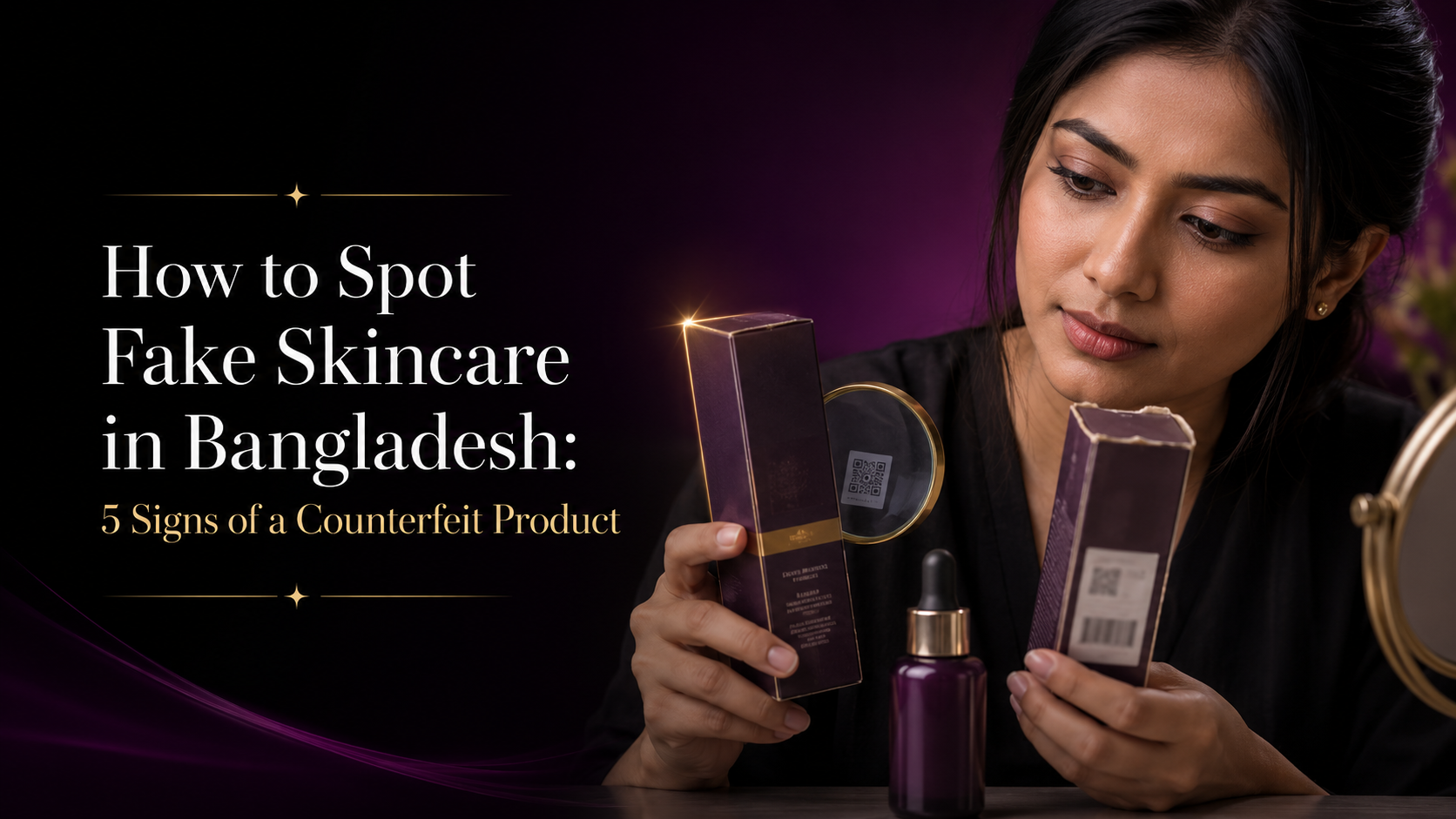
You pick up a Garnier face wash. The packaging looks right. The price is reasonable. But something feels slightly off.
It might be.
According to the Consumers Association of Bangladesh, an estimated 70% of cosmetics available in the local market are counterfeit or substandard. And in February 2025, BSTI raided a Dhaka factory that was literally refilling empty bottles of Johnson’s, Sunsilk, Dove, and Head & Shoulders with low-grade chemicals, then resealing them for sale.
Fake skincare is not a fringe problem in Bangladesh. It is a mainstream one.
The good news: counterfeit products, however well-disguised, almost always leave traces. Once you know what to look for, spotting a fake becomes a lot easier. Here are the five most reliable signs.
Sign 1: The Packaging Looks “Almost Right” But Not Quite
Counterfeiters copy packaging, but rarely perfectly. Their margins are thin, so quality shortcuts show up in the details.
When you pick up a skincare product, examine these closely:
Font consistency. Brand logos use specific typefaces with precise kerning and weight. On a fake, letters may look slightly bolder, thinner, or unevenly spaced. Hold it next to the brand’s official website image if you can.
Print quality. Legitimate products use high-resolution print on firm, consistent packaging. Fakes often show faint colour bleeding, slightly blurry text, or inconsistent label alignment.
Texture and material. Run your fingers over the packaging. Does it feel the same as products you’ve bought before from the brand? Cheap plastic, flimsy caps, or lids that don’t seat firmly are common giveaways.
Language and spelling. Many counterfeit products sold in Bangladesh contain translation errors, missing punctuation, or awkward phrasing in English. Read ingredient lists carefully,y genuine international brands use precise, standardised language.
Smell on first opening. If a moisturiser smells unusual, overly chemical, or nothing like what you’d expect from that brand, trust your nose. The formulation has almost certainly been changed.
Quick check: Search for official product images on the brand’s global website or verified retailer pages and compare side by side before buying.
Sign 2: There’s No Batch Code, or It Doesn’t Match
Every legitimate skincare product carries a batch code (also called a lot number). This is a string of numbers and sometimes letters, typically printed on the bottom of the container or at the base of the tube. It exists so brands can trace exactly when and where a product was manufactured.
Counterfeit products frequently have no batch code at all. Or they carry a code that has been copied from another product and stamped repeatedly with the same number appearing on every unit in a batch, which is not how authentic production works.
How to verify a batch code:
Use a free tool called CheckFresh or CheckCosmetic. Enter the batch code and brand name. The tool will return the manufacture date and estimated expiry. If it returns no data or the date is impossible, the code is likely fake.
For K-beauty products specifically, Korean brands like COSRX, Some By Mi, and Innisfree print batch codes that align directly with their manufacturing records. Legitimate sellers can always verify these on request.
Sign 3: The Price Is Suspiciously Low
This is the most intuitive sign and the most frequently ignored.
A 50ml Neutrogena Hydro Boost Water Gel retails at a known price point globally and in Bangladesh. If someone is offering it at 40–50% below that price, the product is almost certainly not authentic.
The economics are simple. A legitimate importer pays customs duty, handles shipping, stores inventory, and builds in a margin. A counterfeiter pays for cheap raw materials and packaging. There is no version of a real product that can be priced like a fake.
Where this is most common:
- Facebook and Instagram shop pages with no physical address
- WhatsApp resellers with no visible sourcing
- Marketplace listings where the seller has no reviews or history
- “Wholesale” offers on products that don’t have an authorised wholesale channel in Bangladesh
A heavily discounted price is never a deal. It is a warning.
Sign 4: The Seller Cannot Name an Authorised Source
Ask any seller one question: Where do you source your products?
A legitimate retailer will answer this confidently. They will name an authorised distributor, an import certificate, or a direct brand relationship. Some will show paperwork.
A seller moving counterfeit goods cannot answer this question clearly. You will get vague answers: “direct import,” “international supplier,” or “original guaranteed” with nothing to back it up.
What authorised sourcing looks like in Bangladesh:
For global brands like Neutrogena, CeraVe, L’Oréal, and Garnier, Bangladesh has authorised distributors whose names are listed on the brand’s regional or Asia-Pacific websites. Cross-check the seller’s name against these lists.
For Korean skincare brands, look for retailers who are listed on the brand’s official global store locator or who can show import documentation. Bangladesh does not yet have many authorised K-beauty distributors, which is precisely why buying from a verified source matters.
At Kioraa, every product comes with sourcing verification. We do not list a product unless we can stand behind where it came from. If you ever want to know the source of a specific product, ask us, and we’ll tell you.
Sign 5: No BSTI Information or Proper Labelling
Under Bangladesh law, all imported cosmetics must carry BSTI (Bangladesh Standards and Testing Institution) approval or, at a minimum, comply with BSTI labelling standards. Yet according to a Consumer Association of Bangladesh survey, 45% of cosmetic products in the market lack BSTI certification, and a striking 75% do not include the manufacturer’s address.
A compliant imported skincare product must show:
- Product name and brand
- Country of origin
- Manufacturer’s full name and address
- Ingredients list (INCI-compliant)
- Net weight or volume
- Manufacturing and expiry dates
- Importer’s name and contact details in Bangladesh
If any of these are missing, particularly the importer’s details and expiry date, the product has not been legally imported. That doesn’t always mean it’s fake (some genuine parallel imports skip labelling), but it does mean it has entered the country without proper oversight and carries no consumer protection.
Why This Matters Beyond Aesthetics
It is easy to think of fake skincare as a financial inconvenience; you paid for a Garnier and got something else. But the health risks go further.
Counterfeit cosmetics seized in Bangladesh have been found to contain mercury, lead, arsenic, steroids, and parabens at levels far above safe thresholds. These aren’t abstract risks. Mercury-based skin-lightening creams have caused documented cases of kidney damage and neurological harm. Lead in lipstick accumulates over time. Unregulated steroids in face creams thin the skin with prolonged use.
The BSTI tested 34 imported cosmetics samples and found 17 to be adulterated, unapproved, or substandard. That is one in two.
Your skin is not a surface to experiment on.
How to Buy Skincare Safely in Bangladesh
Applying the five checks above works, but it requires effort every time. The more reliable approach is to reduce the risk at the source by buying from a retailer you trust.
At Kioraa, we built our entire store around the problem this article describes. We know that authenticity anxiety is the number one barrier for skincare buyers in Bangladesh, because we hear it from customers every day. So we did the work to solve it: direct sourcing, verified imports, and transparent product information on every listing.
You should not have to become a counterfeit detective every time you buy a face wash. That’s our job.
The Bottom Line
Fake skincare in Bangladesh is widespread, well-disguised, and genuinely harmful. But it is not undetectable. Check the packaging quality, verify the batch code, question prices that seem too good, ask your seller where they source from, and look for proper labelling.
Better yet, buy from a store that has already done all of this for you.